Recently, a joint research team led by Prof. Shan Chongxin from Zhengzhou University and Prof. Sun Jian from the School of Physics at Nanjing University has made important progress in the study of hexagonal diamond. By combining extreme-condition experiments and machine-learning-driven theoretical simulations, the team successfully synthesized millimetre-sized bulk hexagonal diamond with high phase purity and revealed the microscopic graphite–hexagonal diamond phase transformation mechanism.
This work provides new insights into the long-standing question of whether hexagonal diamond can exist as an independent carbon phase and advances the understanding of carbon phase transitions under extreme conditions. Shoulong Lai, Xigui Yang, and Jiuyang Shi are the co-first authors of the paper. The corresponding authors are Xigui Yang, Jian Sun, Shaobo Cheng, and Chongxin Shan. The research results were published on March 5, 2026, in the journal Nature under the title "Bulk hexagonal diamond."
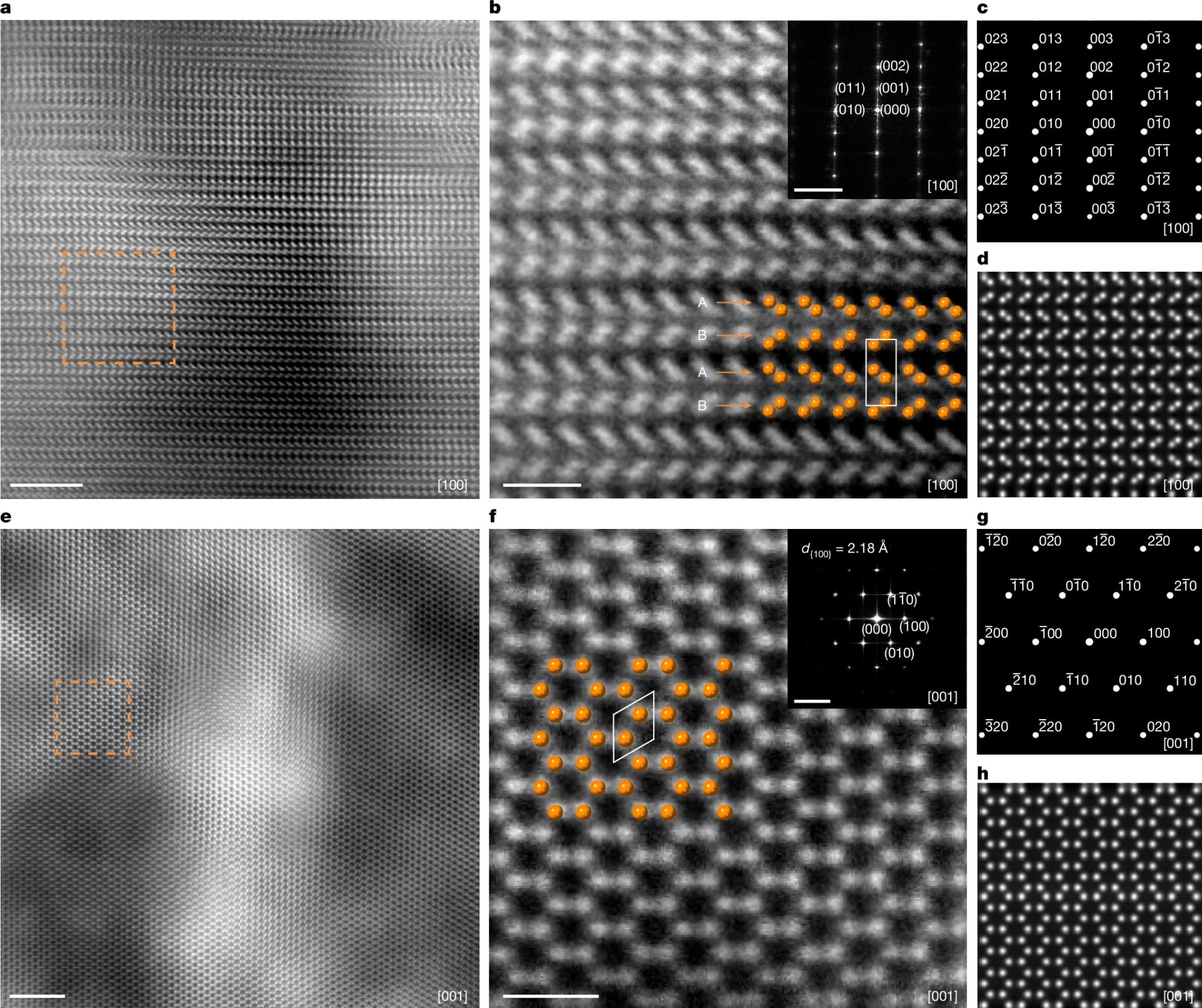
Figure: Atomic structure of the bulk HD recovered from 20 GPa and 1,300 °C.
Thesis abstract:
Known as the 'ultimate semiconductor', cubic diamond (CD) has gained substantial interest both scientifically and industrially. Its polymorph, hexagonal diamond (HD), is even more intriguing because of its fascinating properties associated with the meteorite impacts1,2,3,4,5,6,7,8. As no solid experimental evidence has been provided to prove its existence, the physical properties of HD remain largely unexplored. Here we report the synthesis of millimetre-sized, phase-pure HD from highly oriented pyrolytic graphite (HOPG) compressed along the c-axis at elevated temperatures. Combining advanced structural characterizations and theoretical simulations, we confirm the identity of HD and clarify the transformation pathway from graphite. Bulk HD exhibits a slightly higher hardness than CD and high thermal stability. These findings resolve the long-standing controversy on the existence of HD as a discrete carbon phase and provide new insight into the graphite-to-diamond phase transition, paving the way for future research and practical use of HD in advanced technological applications.
Source: Bulk hexagonal diamond | Nature


